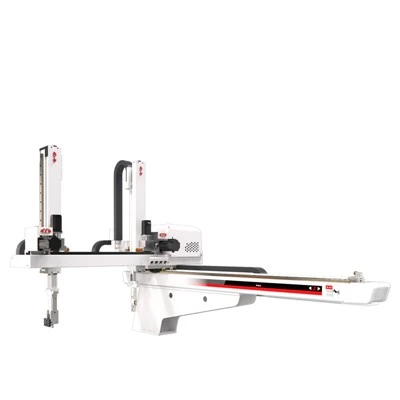
Hey there! I’m a supplier of injection molding robots, and today I wanna chat about how these nifty machines handle part deburring. It’s a crucial step in the manufacturing process, and our robots are pretty good at it. Injection Molding Robot
Understanding Part Deburring
First off, let’s talk a bit about why deburring is so important. When a part is molded, there are often rough edges, excess material, or flash left over. These imperfections can not only make the part look bad but also affect its functionality. For example, in automotive parts, rough edges can interfere with the proper fit of components, leading to potential mechanical failures. In medical devices, burrs can be a safety hazard, causing irritation or even injury.
Deburring is the process of removing these unwanted imperfections to ensure that the part meets the required quality standards. There are different methods of deburring, including manual, mechanical, and chemical. But here’s where our injection molding robots come in to save the day.
How Our Robots Approach Deburring
Precision Programming
One of the key advantages of our injection molding robots is their precision programming. We can program the robot to follow a specific path around the part, ensuring that it removes all the burrs without damaging the part itself. This is done using advanced CAD/CAM technology, which allows us to create a detailed 3D model of the part. The robot then uses this model to navigate around the part, making micro-adjustments as it goes.
For example, let’s say we’re making a plastic housing for a smartphone. The robot can be programmed to follow the exact contour of the housing, removing any burrs along the edges and around the cutouts for the buttons and ports. This level of precision is difficult to achieve with manual deburring, which is often prone to human error.
Tool Selection
Another important aspect of deburring is tool selection. Our robots are equipped with a variety of tools, each designed for a specific type of deburring task. For example, we have abrasive wheels for removing large burrs, as well as fine-tuning tools for removing small, hard-to-reach burrs.
The robot can automatically select the appropriate tool for the job based on the type of part and the location of the burrs. This not only saves time but also ensures that the deburring process is as efficient as possible. For instance, if the part has a lot of sharp edges, the robot might use a carbide-tipped tool to quickly remove the burrs. On the other hand, if the part is made of a soft material, a more gentle abrasive might be used to avoid damaging the surface.
Force Control
Force control is also a critical feature of our injection molding robots. We can program the robot to apply just the right amount of force when deburring the part. This is important because applying too much force can damage the part, while applying too little force might not remove the burrs completely.
Our robots use sensors to detect the amount of force being applied and make adjustments in real-time. For example, if the robot encounters a particularly stubborn burr, it can increase the force slightly to ensure that the burr is removed. Once the burr is gone, the robot can reduce the force to avoid damaging the part. This level of control is what sets our robots apart from other deburring methods.
Benefits of Using Our Injection Molding Robots for Deburring
Increased Efficiency
One of the biggest benefits of using our robots for deburring is increased efficiency. Manual deburring is a time-consuming process that requires a lot of labor. With our robots, the deburring process can be completed much faster, allowing you to increase your production capacity.
For example, let’s say you have a production line that produces 100 parts per hour. If manual deburring takes an average of 10 minutes per part, that’s a total of 1000 minutes (or over 16 hours) of deburring time per hour of production. With our robots, the deburring time can be reduced to just a few minutes per part, allowing you to produce more parts in less time.
Consistency and Quality
Another benefit of using our robots is consistency and quality. Manual deburring is often inconsistent, with different operators applying different levels of force and using different techniques. This can result in parts that have varying levels of quality.
Our robots, on the other hand, are programmed to follow the same path and apply the same amount of force every time. This ensures that every part is deburred to the same high standard, reducing the number of defective parts and improving overall product quality.
Cost Savings
Using our robots for deburring can also result in significant cost savings. While the initial investment in a robot may be higher than hiring a manual laborer, the long-term savings can be substantial. Robots don’t require breaks, vacations, or health insurance, and they can work 24/7 without getting tired.
In addition, the increased efficiency and quality of our robots can lead to reduced waste and rework, which can further save you money. For example, if you’re able to reduce your defective parts rate from 5% to 1%, that’s a significant cost savings over time.
Real-World Applications
Our injection molding robots have been used in a variety of industries for part deburring. Here are a few examples:
Automotive Industry
In the automotive industry, our robots are used to deburr a wide range of parts, including engine components, interior trim, and exterior body panels. For example, they can be used to deburr the edges of a plastic dashboard to ensure a smooth, high-quality finish.
Medical Device Industry
In the medical device industry, our robots are used to deburr parts such as syringes, catheters, and surgical instruments. The precision and cleanliness of our robots are essential in this industry, where even the smallest burr can pose a safety risk.
Electronics Industry
In the electronics industry, our robots are used to deburr parts such as smartphone housings, computer keyboards, and printer cartridges. The ability to remove burrs without damaging the delicate electronic components is crucial in this industry.
Wrapping Up
In conclusion, our injection molding robots are a great solution for part deburring. They offer precision programming, a variety of tools, force control, increased efficiency, consistency and quality, and cost savings. Whether you’re in the automotive, medical device, electronics, or any other industry, our robots can help you improve your production process and produce high-quality parts.
If you’re interested in learning more about how our injection molding robots can handle part deburring for your business, don’t hesitate to reach out. We’re always happy to have a chat and see how we can help you take your manufacturing process to the next level. Contact us to start a discussion about your specific needs and how our robots can fit into your production line.
Industrial Robot References
- "Injection Molding Handbook" by Rosato and Rosato
- "Automated Manufacturing Systems and Computer-Integrated Manufacturing" by Groover
- Industry whitepapers on injection molding and deburring technologies
Robotic Technology (GD) Co., Ltd.
Robotic Technology (GD) Co., Ltd. is one of the most experienced injection molding robot manufacturers and suppliers in China, also supports custom service and one year warranty. Please feel free to wholesale CE approved injection molding robot for sale here from our factory. Contact us for quotation.
Address: Room 102, No. 30,Hengfeng 2nd Road,Daguo, Changping Town, Dongguan City,Guangdong,China
E-mail: admin@iroboticplus.com
WebSite: https://www.rb-tic.com/
