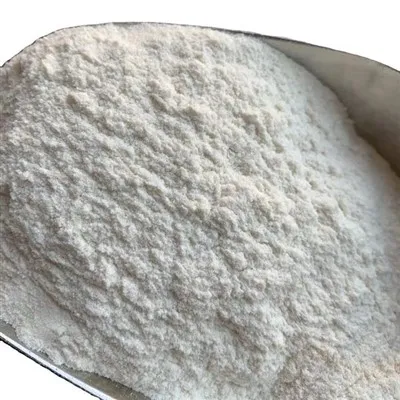
Hey there! As a supplier of xanthan gum, I’ve gotten a ton of questions about how it affects the stability of emulsions. So, I thought I’d dive into this topic and share what I’ve learned over the years in the industry. Xanthan Gum
First off, let’s break down what an emulsion is. You can think of an emulsion as a mixture of two liquids that usually don’t mix well together, like oil and water. In nature, those two would just separate pretty quickly. But in a lot of products we use every day, like salad dressings, lotions, and even some types of paints, we need them to stay mixed. That’s where the stability of an emulsion comes in.
Now, xanthan gum is a pretty amazing ingredient when it comes to emulsion stability. It’s a polysaccharide, which is just a fancy word for a type of complex sugar. It’s produced by fermenting carbohydrates with a bacteria called Xanthomonas campestris. Sounds a bit weird, but trust me, it works wonders!
One of the main ways xanthan gum helps with emulsion stability is by increasing the viscosity of the continuous phase of the emulsion. In an oil – water emulsion, for example, if the water is the continuous phase, adding xanthan gum will make the water thicker. When the continuous phase is more viscous, it becomes harder for the droplets of the dispersed phase (in this case, the oil droplets) to move around and come together. This reduces the chances of coalescence, which is when the droplets merge and eventually cause the emulsion to break.
Let me give you a little analogy. Imagine you’re trying to move marbles through honey. It’s a lot harder than moving them through water, right? Well, that’s kind of what happens to the oil droplets in an emulsion when you add xanthan gum. The increased viscosity of the continuous phase acts like that thick honey, making it difficult for the oil droplets to bump into each other and combine.
Another cool thing about xanthan gum is its ability to form a network structure. When you dissolve xanthan gum in a liquid, the molecules start to interact with each other and form a sort of three – dimensional web. This network can trap the droplets of the dispersed phase, holding them in place and preventing them from separating.
This network formation also helps with something called creaming. Creaming is when the droplets in an emulsion rise to the top (if they’re less dense than the continuous phase) or sink to the bottom (if they’re more dense). The network formed by xanthan gum can resist the forces that cause creaming, keeping the emulsion more uniform over time.
I remember one time, a customer who was making a vegan mayonnaise reached out to me. They were having trouble with the oil separating from the water – based phase. After suggesting they add a small amount of xanthan gum, they were blown away by the difference. The mayonnaise became much thicker and more stable, and it stayed that way for a longer period without any signs of separation.
The concentration of xanthan gum also plays a crucial role in emulsion stability. Generally, as you increase the concentration of xanthan gum, the stability of the emulsion improves. But there’s a limit. If you add too much xanthan gum, the emulsion can become too thick, which might not be desirable depending on the application. For example, in a salad dressing, you want it to be pourable. If you add an excessive amount of xanthan gum, it’ll turn into a gloopy mess that no one wants to use.
The pH of the emulsion is another factor to consider. Xanthan gum is pretty stable over a wide range of pH values, from about 2 to 12. But in extreme pH conditions, its performance can be affected. For instance, at very low pH values, the structure of xanthan gum might break down a bit, reducing its ability to stabilize the emulsion.
Temperature also has an impact. Xanthan gum is stable at normal room temperatures, and it can even withstand some heating and cooling cycles. However, if you expose the emulsion to extremely high temperatures for a long time, the xanthan gum might start to lose its effectiveness.
Now, you might be wondering how xanthan gum compares to other emulsifying agents. Well, there are plenty of other options out there, like lecithin, which is a natural emulsifier found in eggs and soybeans. Lecithin works by reducing the surface tension between the two liquids in the emulsion. While it’s a great option, it doesn’t offer the same thickening and network – forming properties as xanthan gum.
On the other hand, some synthetic emulsifiers can provide similar levels of stability, but they might not be as appealing to consumers who are looking for more natural ingredients. Xanthan gum is a natural product, which makes it a popular choice for food, cosmetic, and other industries that are moving towards more "clean – label" products.
In the food industry, xanthan gum is used in all sorts of products. In ice creams, it helps prevent the formation of ice crystals by stabilizing the emulsion of fat and water. In ketchups, it keeps the consistency uniform and prevents the separation of the tomato solids from the liquid. And in breads, it can improve the texture by helping to hold the water and oil together in the dough.
In the cosmetic industry, xanthan gum is used in creams, lotions, and gels. It helps to give these products a smooth texture and keeps the oil and water phases from separating. This is important because if a cosmetic product separates, it doesn’t look good and might not perform as well.
So, if you’re in an industry that uses emulsions and you’re struggling with stability issues, xanthan gum could be the solution you’ve been looking for. Whether you’re making food products, cosmetics, or even industrial coatings, it can make a big difference.
If you’re interested in learning more about how xanthan gum can work for your specific application or if you’d like to discuss a potential purchase, don’t hesitate to reach out. I’m here to help you find the right product and answer any questions you might have.
Remember, getting the right amount and understanding how it interacts with other ingredients in your formula is key to achieving the best results. I’ve worked with countless customers to fine – tune their formulations, and I’m confident I can do the same for you.
Let’s start a conversation and see how xanthan gum can take your emulsion – based products to the next level. Feel free to drop me a message, and we’ll work something out together.
Colorants References
- McClements, D. J. (2015). Food Emulsions: Principles, Practice, and Techniques. CRC Press.
- Dickinson, E. (2010). Stabilization of emulsions and foams with particles. Current Opinion in Colloid & Interface Science, 15(1), 40 – 49.
- Whistler, R. L., & BeMiller, J. N. (Eds.). (1993). Industrial Gums: Polysaccharides and Their Derivatives. Academic Press.
Fudijia (Tianjin) Supply Chain Co., Ltd.
With abundant experience, we re one of the most professional xanthan gum manufacturers and suppliers in China. We warmly welcome you to wholesale bulk high quality xanthan gum made in China here from our factory. For more information, contact us now.
Address: 301-2-1C,Jin Bin Jie Zuo,No.98, Huanghai Road,TEDA, Tianjin, China
E-mail: foodchem@hjlfoods.com
WebSite: https://www.ifoodchem.com/
