If you’ve ever walked through a large commercial building at 2 a.m. when every office and shop is dark, but the HVAC system is still humming steadily, there’s a good chance a screw chiller is doing the heavy lifting. For anyone in the building services space, or even for facility managers trying to cut energy costs, one of the most common questions we get as screw chiller suppliers is this: How energy efficient are these units, really? It’s not a one-word answer, I’ll admit—efficiency depends on a lot of moving parts (literally and figuratively), and over the 12 years I’ve worked in this industry, I’ve seen clients write off screw chillers entirely because they confused an outdated unit with the modern models we design and install today. Let me break this down the way I do when I’m sitting across from a facility manager, notebook in hand: plain talk, backed by the numbers, and honest about what efficiency means for their bottom line. Screw Chillers

First, let’s get one thing straight: energy efficiency for chillers isn’t just a single number you see on a spec sheet. It’s measured in two main ways, and mixing them up is where a lot of mistakes happen. The first is EER—Energy Efficiency Ratio— which is the cooling output in British Thermal Units (BTUs) divided by the power input in watts, tested at a fixed, standard temperature. That number is useful for apples-to-apples comparisons between similar-sized units, but it’s a laboratory figure, not how a chiller will perform in the real world. The second, and way more important for most clients, is IPLV or NPLV—Integrated Part-Load Value, or Non-Standard Part-Load Value. This measures efficiency across different operating loads, because buildings don’t run at full cooling capacity 24/7. On a mild spring day, a chiller might only need to run at 30% of its capacity; on a sweltering July afternoon, it’s at 100%. A unit that’s very efficient at full load but wastes energy when it’s lightly loaded will cost a lot more to run over a year, and that’s where screw chillers have a big advantage over older technologies like reciprocating chillers.
Back in the day, reciprocating chillers (the ones with the piston-like compressors) struggled with part-load efficiency because they’d cycle on and off repeatedly, using more energy every time they start up. Screw compressors, on the other hand, are designed to modulate capacity smoothly. Modern screw chillers use variable speed drives (VSDs) on both the compressor and the cooling fans, so they can adjust their output to match exactly what the building needs, rather than shutting down and starting up. For most commercial applications, which run at part load 70-80% of the time, that’s a game-changer. I had a client last year— a 10-story office building in downtown Houston— that was using an old reciprocating chiller that pulled 1.2 kW per ton at 50% load. When we swapped it out for a modern VSD screw chiller, their part-load kW dropped to 0.58 kW per ton. Multiply that by 12 months of operation, and their annual energy bill for cooling went down by $27,000. That’s not a small number, and it’s the kind of savings that makes clients stop and listen.
But screw chillers aren’t one-size-fits-all, and their efficiency does depend on a few key design choices. Let’s talk about the compressor first, because that’s the heart of the unit. We design our screw compressors with precision-machined rotors— the male and female screws that trap and compress refrigerant. If the tolerances are off even by a fraction of a millimeter, you get internal leakage, where refrigerant slips back through the compressor instead of being pumped through the system, and that kills efficiency. Ten years ago, many screw compressors were made with cast rotors, which had looser tolerances and higher leakage. Now, we use CNC-machined rotors, and pair them with advanced oil separation systems. Oil is used to lubricate and seal the compressor, but if too much oil gets into the refrigerant circuit, it acts like an insulator and reduces heat transfer. Our oil separators get 99.5% of the oil out before the refrigerant leaves the compressor, so the evaporator and condenser can do their jobs as efficiently as possible. That’s a small detail, but it adds up to 5-10% better efficiency over a unit with a basic oil separator.
Next, the refrigeration loop itself. Most modern screw chillers use HFC refrigerants like R-134a, but a lot of newer models, including ours, are moving to low-GWP (Global Warming Potential) refrigerants like R-513A, which is just as efficient as R-134a but has a 56% lower environmental impact. The thing about low-GWP refrigerants is that they require slightly different component designs, but when done right, the efficiency doesn’t drop at all. I’ve had clients worry that switching to a more eco-friendly refrigerant would mean higher energy bills, but that’s not the case when you pair it with a well-designed screw chiller. Another big factor is the heat exchangers— the evaporator that absorbs heat from the building’s water, and the condenser that rejects that heat outside. We use brazed plate heat exchangers in some of our smaller screw chillers, and shell-and-tube heat exchangers for larger units, because they have a larger surface area for heat transfer, so the refrigerant can be cooled and heated more effectively. When heat transfer is better, the compressor doesn’t have to work as hard, which translates directly to lower energy use.
Wait, let’s be honest— screw chillers do have a reputation for being less efficient at very low loads, right? If a building only needs 10% cooling on a cool night, can a screw chiller keep up without wasting energy? It depends on the unit, but modern VSD screw chillers can modulate down to 10-15% of their full capacity, which is more than enough for most applications. Older screw chillers without VSDs would only go down to 30-40% load, so they’d either have to cycle or run inefficiently at low loads, but that’s not the case with the latest models. I worked on a hospital project last year, where they needed reliable cooling around the clock, even during the winter when only the operating rooms and some labs needed cooling. We installed two screw chillers with VSDs, and at 12% load, each one was running at 0.6 kW per ton, which is way better than any other chiller type at that low load.
Another point that a lot of people miss: efficiency over the unit’s lifespan. A lot of clients look at the upfront cost of a screw chiller and compare it to an air-cooled scroll chiller, which is cheaper, but scroll chillers have a shorter lifespan and much higher maintenance costs. I’ve seen scroll chillers that start having major efficiency drops after 5-7 years, because the compressor wears out faster. Screw chillers, when maintained properly, can run for 20-25 years, and even after 10 years, they still operate at 90% of their original efficiency. That means over the life of the unit, the total cost of ownership (TCO) for a screw chiller is way lower than a cheaper, less efficient alternative. Last quarter, a retail chain client of mine was trying to save $15,000 upfront by going with a scroll chiller, but when we ran the numbers, their 15-year TCO would be $120,000 higher than if they went with our screw chiller. They switched, and they’ve already saved $8,000 in the first 10 months of operation.
Of course, efficiency isn’t just about the chiller itself— it’s about how it’s installed and operated. I’ve seen perfectly good screw chillers installed wrong, with dirty water in the piping or improper air flow across the condenser, and their efficiency dropped by 20% or more. That’s why we don’t just sell a chiller and walk away— we work with our clients’ contractors to make sure the piping is sized correctly, the water treatment program is set up right to keep the heat exchangers clean, and the controls are programmed to run the chillers in the most efficient sequence. For example, if a building has two screw chillers, we can set the controls to run the more efficient unit first, or stage them based on load, so you never run two units when you only need one. A lot of facility managers don’t realize that bad operation can kill efficiency as much as a low-quality unit.
Let’s also talk about common myths that I hear all the time. One is that water-cooled screw chillers are always more efficient than air-cooled ones. That used to be true, but air-cooled screw chillers with VSDs and advanced condenser coils are now almost as efficient as water-cooled ones, and they don’t need a separate cooling tower, which saves on maintenance and water costs. For a small to medium-sized building that doesn’t have space for a cooling tower, an air-cooled screw chiller is a great option. Another myth is that screw chillers are only for large commercial buildings. We manufacture screw chillers starting at 5 tons, which is small enough for a restaurant or a small office building, and they’re just as efficient as the larger units. I installed a 7-ton air-cooled screw chiller for a coffee roaster in Portland last year, and their cooling cost went down by 35% compared to their old unit.
Now, let’s get to the numbers, because that’s what everyone wants to see. For a typical 100-ton screw chiller, the full-load EER is around 12-14, and the IPLV is around 18-22. For comparison, a comparable scroll chiller has a full-load EER of 10-12 and an IPLV of 13-16. That means over a year of part-load operation, the screw chiller uses 20-30% less energy than a scroll. For a 500-ton screw chiller, full-load EER is around 14-16, IPLV up to 24. Those numbers are verified by AHRI (Air-Conditioning, Heating, and Refrigeration Institute), which is the independent body that certifies chiller efficiency, so they’re not just made up by our sales team.
But here’s the thing: efficiency isn’t the only factor, but it’s the biggest one when it comes to operating costs. I always tell clients to stop looking at the spec sheet EER, and start looking at their own usage patterns. How many hours a day does the chiller run? What’s the average load it operates at? What’s the local electricity rate? Those are the numbers that will tell you if a screw chiller is right for you. For example, a building in California with high electricity rates will save way more with a high-efficiency screw chiller than a building in a state with lower rates, because every kWh saved is worth more.
At the end of the day, when we’re talking about screw chiller energy efficiency, it’s not about saying they’re the best for every job. It’s about saying that for the vast majority of commercial, industrial, and even small applications, they offer a combination of part-load efficiency, long lifespan, and low total cost of ownership that’s hard to beat. The old days of inefficient, constant-speed screw chillers are gone— modern units with VSDs, advanced compressors, and smart controls are designed to save energy, lower utility bills, and be reliable for decades.
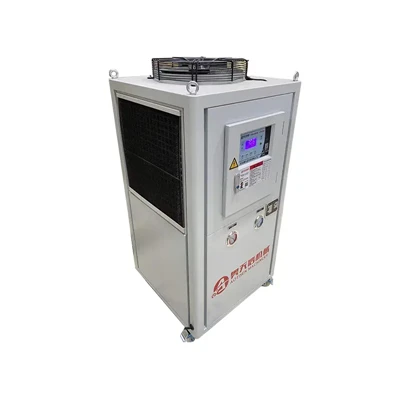
If you’re looking to replace an old chiller, or are specifying a new system for your building, I’d be happy to walk you through the numbers, answer any questions you have about efficiency, and help you find the right screw chiller for your needs. We don’t do one-size-fits-all, and we don’t push units that aren’t efficient for your specific operation. We just focus on building products that save our clients money, while keeping their spaces comfortable year-round. Whether you’re a facility manager at a hospital, an engineer working on a new retail development, or a business owner looking to cut energy costs, don’t hesitate to reach out to discuss your requirements.
Chiller Unit References:
- Air-Conditioning, Heating, and Refrigeration Institute (AHRI). 2024 Chiller Efficiency Standards and Certification Program.
- ASHRAE. 2023 HVAC Applications Handbook: Chilled Water Systems.
- International Energy Agency (IEA). 2022 Cooling Equipment Energy Efficiency Report.
- U.S. Department of Energy. 2024 Best Practices for Chiller System Efficiency.
- Carrier Corporation. 2023 Screw Chiller Design and Performance Data.
Kunshan Aotianxin Machinery Co., Ltd.
We’re well-known as one of the most reliable screw chillers manufacturers in China. With abundant experience, our factory offer high quality screw chillers made in China with low price. If you have any enquiry about quotation and free sample, please feel free to email us.
Address: 550 Shengguang Road, Bacheng Town, Kunshan City, Jiangsu Province
E-mail: 1516722561@qq.com
WebSite: https://www.atxks.com/
